
The plastics problem: inventing and forgetting sciences of synthetic harms
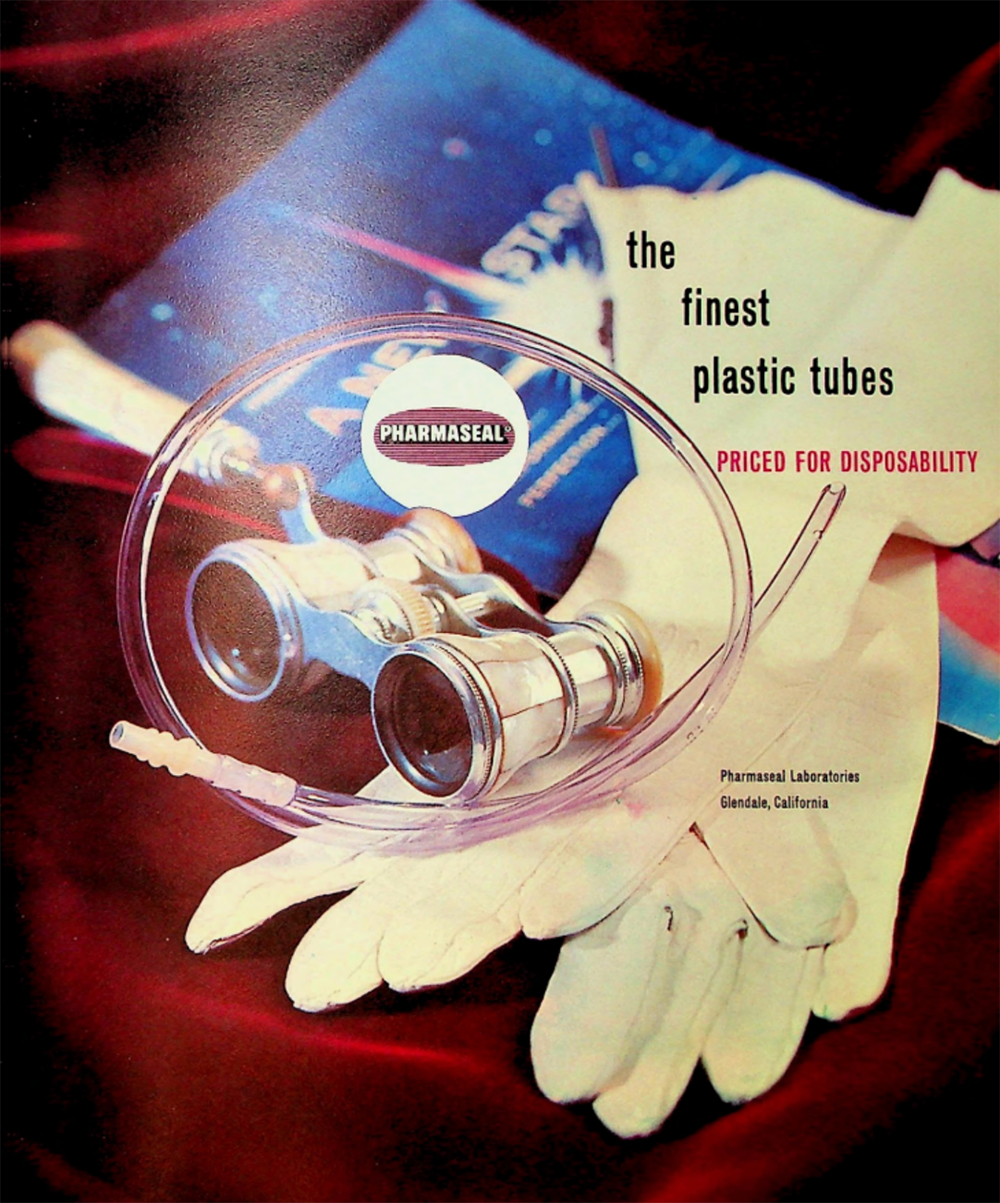
Pharmaseal advert for plastic tubing from the 1960s.
Body
At HSS 2026, Jeremy Greene presented ‘The Plastics Problem: Inventing and Forgetting Sciences of Synthetic Harms’ as part of Plastic Amnesias I, chaired by Anne Kveim Lie.
The presentation returned to May of 1967: Earl Meyers, head of the Manufacturing Controls Branch of the United States Food & Drug Administration had a plastics problem. Ductile, moldable, lightweight, transparent, sterilizable, and allegedly inert, the midcentury explosion of plastic polymers promised boundless horizons for biomedical ingenuity. But as Meyers reckoned, the original promise, “that plastics were quite inert and no serious problems could develop” in switching from glass or steel or rubber to these novel polymers was not holding up. As plastic use increased exponentially, so did reports of unanticipated synthetic hazards. Syringes and pill bottles became discolored and occasionally dissolved when certain drugs were inserted, and patients described inflammatory and allergic reactions to plastic tubing, contact lenses, and blood bags, and physicians, pharmacists, and nurses worried that plasticizers and stabilizers might leach toxins into patient’s bodies.
“The plastic problem,” as a pair of hospital pharmacists wrote, “is not unique to the United States but appears to exist to various degrees in all countries.” In the early 1960s, the Pharmaceutical Manufacturers Association (PMA) founded its own Committee on Plastics to propose new sciences to study how and when a medical plastic could be considered safe and inert. By the time their work reached Meyers’ desk at the FDA, the Society for Plastic Industry (SPI) and the United States Pharmacopoeial Convention (USPC) had joined the PMA effort to reassure regulators that a suite of new sciences could stabilize “medical-grade plastics” as a trustworthy object in the biomedical armamentarium. Yet the credibility of industrially-sponsored regulatory sciences was contested in the 1960s and 1970s by concerned clinician-scientists and consumers groups.
Using materials garnered from Freedom of Information Act (FOIA) requests of the FDA, archives of the USPC, and assorted industry and trade publications, this paper re-assembles the scientific discovery of the health risks of health plastics more than a half-century ago, risks whose brief moment of visibility was largely erased with the successful adoption of “medical grade plastics” as a natural kind in the Medical Device Amendments of 1976.
Read more on the double panel at HSS: here.