
Injecting Hope: The Race for a Covid-19 Vaccine, National Museums Scotland
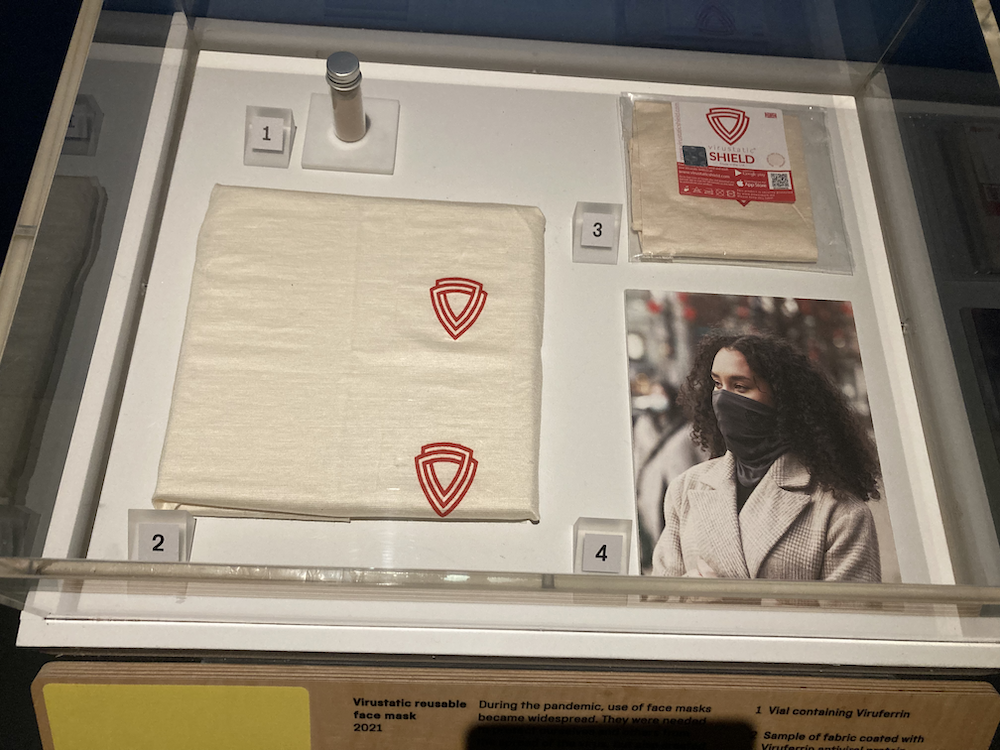
Display case with Virustatic reusable face mask.
Disposability in Focus: An Eco-Perspective on the Exhibition
An exhibition, Injecting Hope, hosted by National Museums Scotland from 25 January – 27 April 2025 explored the research, development, and launch of the global vaccine programme to combat the spread of Covid-19. As it was on our doorstep, the University of Edinburgh project team popped in to see if we might find synergies with our project themes of healthcare waste and design for disposability.
On arrival, a montage of media clips surround the visitor, the clamour and confusion reflecting the uncertainty and overwhelm of the time. Out of this confusion, key messages begin to emerge on how people might limit the spread of the virus, protecting themselves and others by maintaining distance and creating a physical, visible barrier - a face mask. With examples of masks made of materials from cotton to polyester to fish skin, we were reminded of how masks escaped the confines of medical settings and polluted cities to become part of everyday life during the pandemic - their fabrics, patterns and styles becoming a canvas on which individuality might be expressed. Slipping from pockets and bags, the common sight of face masks as litter raised awareness of this new waste stream.
Efforts to design alternatives included the University of Manchester’s Virustatic shield - a washable, reusable face mask which harnessed the antiviral Viruferrin protein to protect the wearer.
This reference to face masks was the only time material waste resulting from the pandemic was mentioned throughout the exhibition. Yet the volume and environmental impact of even this waste stream was lost within the context of positive business innovation to address it. More recently, other wastes relating to PPE have been revealed as a result of an inquiry into government spending during the pandemic - including £925 million wasted on inflated prices and £1 billion spent on kit which was unfit for use. The story of face masks weaves together economic, environmental and social themes, which were merely hinted at, leaving the eco-conscious visitor with more questions than answers.
When it comes to medical waste, face masks represent the tip of the pandemic waste iceberg, with many forms of waste (such as those created during manufacturing, issuing from healthcare settings, or resulting from abandoned kit in warehouses) unseen. The race to create a Covid-19 vaccine is told through the human stories of some of those involved in its development, their words express the weight of their experience whilst their personal effects – t-shirts, coffee mugs - reflect the mundanity of their day-to-day work. The speed at which a vaccine was created is explained through the streamlining of processes and the sidelining of competition in favour of cooperation, with a vaccine created in record time. The scope and scale of its roll-out is communicated through a combination of exhibits showing individual vials of vaccine, machinery built specifically for its production, and video footage of the speed at which these machines worked. But where did the vaccine come from, how was it packaged and administered, and what happened to all these materials once the vaccine was administered? Much of the material story behind the vaccine remains hidden - obscured by the undeniably positive impact of the vaccine on human survival. Yet following the flow of materials used to make this a reality could have much to teach us, both in times of stability and in times of crises.
Turning a corner in the exhibition, a darker underside to the vaccine story is brought to light. The cooperation and collaboration reflected in the race to create a vaccine is replaced by a race to vaccinate, which raises ethical and moral questions over whose lives matter. It is surely no coincidence that the campaigns and protests by social movements such as Black Lives Matter reached peak media attention during 2020-2023. Vaccines, often manufactured in the global south, were bought by the global north, prioritising wealthy, mainly white bodies. An interactive world map provides a strong visual reflection showing the progress of the vaccine rollout globally. The exhibition is a reminder of the echoes of a colonial past reverberating into the present, in which hope is delayed or out of reach for many.
The objects in this exhibition share a perspective on the human story of Covid-19 - the human experience of fear and confusion, the desperate race for a vaccine, followed by the race to vaccinate. Other non-human stories, such as the material stories, remain untold. The question this raises is: do these stories matter? Might the merging of multiple perspectives enrich and complicate how we remember the pandemic? There is much to be learned from this vaccination story - both hopeful and bleak – which could leave us better equipped to deal with future crises.
