
Inside Medical Technology UK 2025: Is Sustainability Back in the Basement?
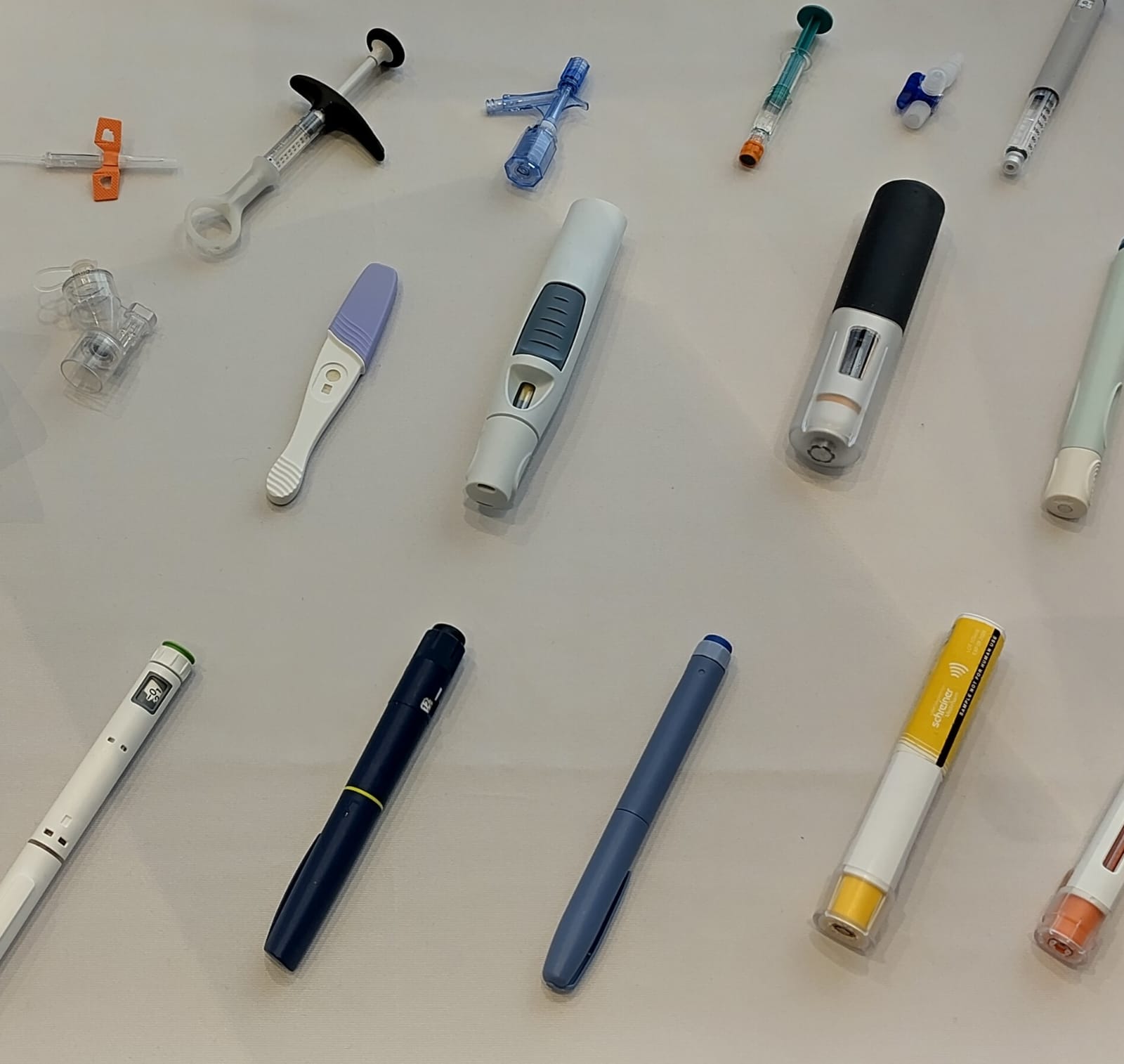
A range of autoinjector types: reusable, smart, and single use.
For a sizeable conference, it was an uncomfortable start. In a juicy, awkward silence ensuing the first talk (Deloitte, on the health system in 2030 (1)) there were no questions and a single, fumbled clap.
I suspect, observing the vast array of telehealth products displayed and the hum around the electronic component, sensor and automation exhibition stands, that no-one doubted her predictions: the Internet of Medical Things and Artificial Intelligence will transform healthcare. There’s certainly plenty of low-hanging fruit (opportunities to improve efficiency in the NHS are not scarce) and tantalising profits to make from digitalisation. Medical devices are increasing in complexity and companies are divesting, merging, forming new partnerships and restructuring to meet the new challenges. The race is on to eliminate bureaucracy and automate slow processes, enabling faster diagnosis, timely treatment and management of chronic conditions from home (2).
In the 1970s it was single-use plastics, not wearables, revolutionising healthcare. They offered comfort and convenience, enabled mass vaccination campaigns and aimed to prevent cross-infection in poorly-equipped healthcare contexts (3,4). They proliferated, and as well as helping, they harmed. Today those harms are accumulating, with microplastics and the chemicals they harbour infiltrating our brains and ecosystems (5–7). I’m sure you’ve heard that medical single-use plastics are mostly made from crude oil, have high carbon footprints (8) and release toxic chemicals when produced and disposed of which cause cancer and affect our ability to reproduce (9). By ignoring the question of safe manufacture and disposal of these products the industry continues to cause widespread harm, including direct injuries to disposal workers, especially in low-resource contexts (10,11).
With this perspective, despite the environmentally-friendly potential of reducing hospital trips and stays, I’m worried about digitalisation. So I asked myself: With the NHS Carbon Reduction Plan (12) and sustainability at least featuring in Deloitte’s 2030 predictions, are things changing?
Honestly, I’m not convinced. You’d be right to enquire whether “Net-Zero” referred to available funding: in just 3 years, the sustainable innovation budget of SBRI Healthcare reduced from £6,000,000 to £0 (13). Clinical engineers, who do the legwork to install, maintain and fix equipment in hospitals - an integral part of a sustainable system (14) - are still (sometimes literally) operating out of a basement, where people can avoid hearing their concerns or consulting them before introducing new tech. One entrepreneur ruefully highlighted that “It has been possible for circa 20 years to produce a sustainable medical device”; the point illustrated by his cost-decimating, award-winning, sustainable device (15). But while there’s a 10% social value weighting on NHS procurement (16), manufacturers claimed that sustainable materials cost 2-4x the price of alternatives (17,18). Plus, they aren’t yet subject to much Extended Producer Responsibility legislation (19,20), so can essentially ignore important disposal questions anyway (21,22). A plastic manufacturer communicated mild annoyance at complicated and contradicting sustainability requirements being made on their materials. At this rate, connected devices may well have higher carbon footprints and more polluting chemicals on board than predicates.
I love, and applaud, the boundless energy in the medtech industry for solving problems, saving lives and making a profit despite the strict regulation and high risks. But how can we encourage everyone to ask more questions?
References
- Life Sciences and Healthcare Predictions 2030 | Deloitte UK [Internet]. [cited 2025 Mar 20]. Available from: https://www.deloitte.com/uk/en/Industries/life-sciences-health-care/collections/life-sciences-and-health-care-predictions.html
- Jafleh EA, Alnaqbi FA, Almaeeni HA, Faqeeh S, Alzaabi MA, Al Zaman K. The Role of Wearable Devices in Chronic Disease Monitoring and Patient Care: A Comprehensive Review. Cureus. 16(9):e68921.
- Borowy I. Medical waste: the dark side of healthcare. História Ciênc Saúde-Manguinhos. 2020 Sep;27(suppl 1):231–51.
- Greene J, Skolnik CL, Merritt MW. How medicine becomes trash: disposability in health care. The Lancet. 2022 Oct 15;400(10360):1298–9.
- Woodall LC, Sanchez-Vidal A, Canals M, Paterson GLJ, Coppock R, Sleight V, et al. The deep sea is a major sink for microplastic debris. R Soc Open Sci. 2014 Dec;1(4):140317.
- Kozlov M. Your brain is full of microplastics: are they harming you? Nature. 2025 Feb 11;638(8050):311–3.
- Publications | Microplastic Research Group [Internet]. 2021 [cited 2025 Mar 21]. Available from: https://mikroplastik.org/en/publications/
- Single-use surgical items contribute two-thirds of carbon footprint of products used in common operations [Internet]. 2023 [cited 2025 Mar 21]. Available from: https://www.rsm.ac.uk/media-releases/2023/single-use-surgical-items-contribute-two-thirds-of-carbon-footprint-of-products-used-in-common-operations/
- Towards PVC-free healthcare | Health Care Without Harm (Europe) [Internet]. [cited 2025 Mar 21]. Available from: https://europe.noharm.org/resources/towards-pvc-free-healthcare
- Street A, Vernooij E, Rogers MH. Diagnostic waste: whose responsibility? Glob Health. 2022 Mar 12;18(1):30.
- Khan MT, Shah IA, Hossain MF, Akther N, Zhou Y, Khan MS, et al. Personal protective equipment (PPE) disposal during COVID-19: An emerging source of microplastic and microfiber pollution in the environment. Sci Total Environ. 2023 Feb 20;860:160322.
- NHS G. Greener NHS » Suppliers [Internet]. [cited 2025 Mar 21]. Available from: https://www.england.nhs.uk/greenernhs/get-involved/suppliers/
- SBRI Healthcare [Internet]. [cited 2025 Mar 21]. SBRI Healthcare - Search our Innovation Portfolio. Available from: https://sbrihealthcare.co.uk/impact-case-studies/company-directory
- Clark D, Dean G, Bolton S, Beeson B. Bench to bedside: The technology adoption pathway in healthcare. Health Technol. 2020 Mar 1;10(2):537–45.
- “Be true to yourself” - an interview with Simon Hall, Director at Airway Medical - Tech South West [Internet]. 2024 [cited 2025 Mar 21]. Available from: https://www.techsouthwest.co.uk/be-true-to-yourself-an-interview-with-simon-hall-director-at-airway-medical/
- Social value in procurement – Procurement Essentials [Internet]. [cited 2025 Mar 21]. Available from: https://www.crowncommercial.gov.uk/news/social-value-procurement-ccs
- Aeschelmann F, Carus M. Biobased Building Blocks and Polymers in the World: Capacities, Production, and Applications–Status Quo and Trends Towards 2020. Ind Biotechnol. 2015 Jun;11(3):154–9.
- Torres Lepe P, Heredia KV, Cárdenas Namur E, Sandoval Fabián GC, García-Enriquez S. 12 - Economics and commercialization of bioplastics. In: Mishra AK, Hussain CM, editors. Bioplastics for Sustainability [Internet]. Elsevier; 2024 [cited 2025 Mar 21]. p. 271–309. Available from: https://www.sciencedirect.com/science/article/pii/B9780323951999000184
- Regulation (EU) 2025/40 of the European Parliament and of the Council of 19 December 2024 on packaging and packaging waste, amending Regulation (EU) 2019/1020 and Directive (EU) 2019/904, and repealing Directive 94/62/EC (Text with EEA relevance) [Internet]. Dec 19, 2024. Available from: http://data.europa.eu/eli/reg/2025/40/oj/eng
- The Producer Responsibility Obligations (Packaging and Packaging Waste) Regulations 2024 [Internet]. King’s Printer of Acts of Parliament; [cited 2025 Mar 28]. Available from: https://www.legislation.gov.uk/ukdsi/2024/9780348264654
- Alfina KN, Ratnayake RMC. Circular Product Development Framework Enhancing Extended Producer Responsibility – A Medical Device Case Study. In: Thürer M, Riedel R, von Cieminski G, Romero D, editors. Advances in Production Management Systems Production Management Systems for Volatile, Uncertain, Complex, and Ambiguous Environments. Cham: Springer Nature Switzerland; 2024. p. 80–96.
- Voudrias EA. Healthcare waste management from the point of view of circular economy. Waste Manag. 2018 May 1;75:1–2.
