
Information gaps in medical-device materials
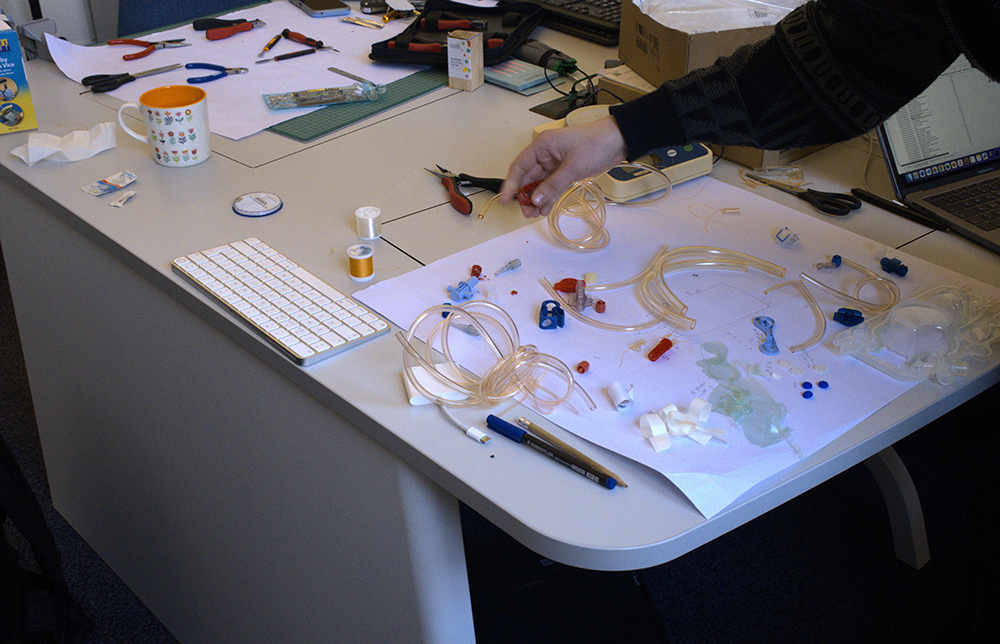
Deconstructing Devices field work in action with Millie Marriott Webb.
Body
At HSS 2026, Millie Marriott Webb presented 'Exposing toxic exposures? Deconstruction, testing and visualisation of material harms from medical devices' as part of Plastic Amnesias II, chaired by Anne Kveim Lie.
Medical devices move through the world on rails of commerce lubricated by international standards - most durably the ISO 13485 standard, hammered out over the course of the early 1990s. Thirty years after ISO 13485 established quality management standards for medical device manufacturers, meticulous component and material traceability remains central to device safety. Responsibility for the safety of materials on medical devices lies with the manufacturer, who must specify quality metrics for and audit their material and component suppliers (Sastri 2022). When faulty devices cause harms to patients or users, this information enables rapid defect identification and for the regulator to act in recalling affected devices. This Post-Market Surveillance system forms the foundation of medical device regulation, with new products approved based on substantial equivalence to existing predicates which do not cause harm in use. This paradigm of course faces a critical blind spot: when harms go undetected and products are incorrectly deemed safe, the implications cascade through predicate-based approvals.
A wide body of research has revealed serious health harms associated with plastics used throughout medical devices. These harms can manifest slowly and outside of clinical settings, during manufacturing or after disposal (Landrigan et al. 2023). They cannot be reported through existing adverse event databases. But the same material information that manufacturers have recorded for three decades is essential not only for identifying plastic products causing harm and reassessing misplaced safety assumptions, but also for enabling circular economy practices like repair and recovery to reduce planetary harms (Hsu et al. 2022).
In recent years, with the advent of Industry 4.0 and digital product passports (Kemmner et al. 2025; Voulgaridis et al. 2024; Ghobakhloo 2020), technological infrastructure for greater materials transparency now exists. This raises a fundamental question: what barriers prevent access to this information that is crucial for protecting human health and advancing healthcare sustainability?
This presentation examined ISO 13485 and ISO 10993, the international standards developed during the 1990s which govern quality management and biocompatibility for medical devices. The standards require manufacturers to test medical plastics for biocompatibility and maintain detailed records about components, materials and suppliers so that faults can be identified and devices recalled. However, the regulatory system is less able to capture harms that emerge slowly, during manufacturing or after disposal.
Marriott Webb considered why material information recorded by manufacturers remains difficult to access, even though it could help identify harmful plastics and question misplaced assumptions of safety. With technologies such as digital product passports now making greater transparency possible, the presentation asked what institutional barriers continue to prevent this knowledge from supporting patient safety, repair and material recovery.
Read more on the double panel at HSS: here.